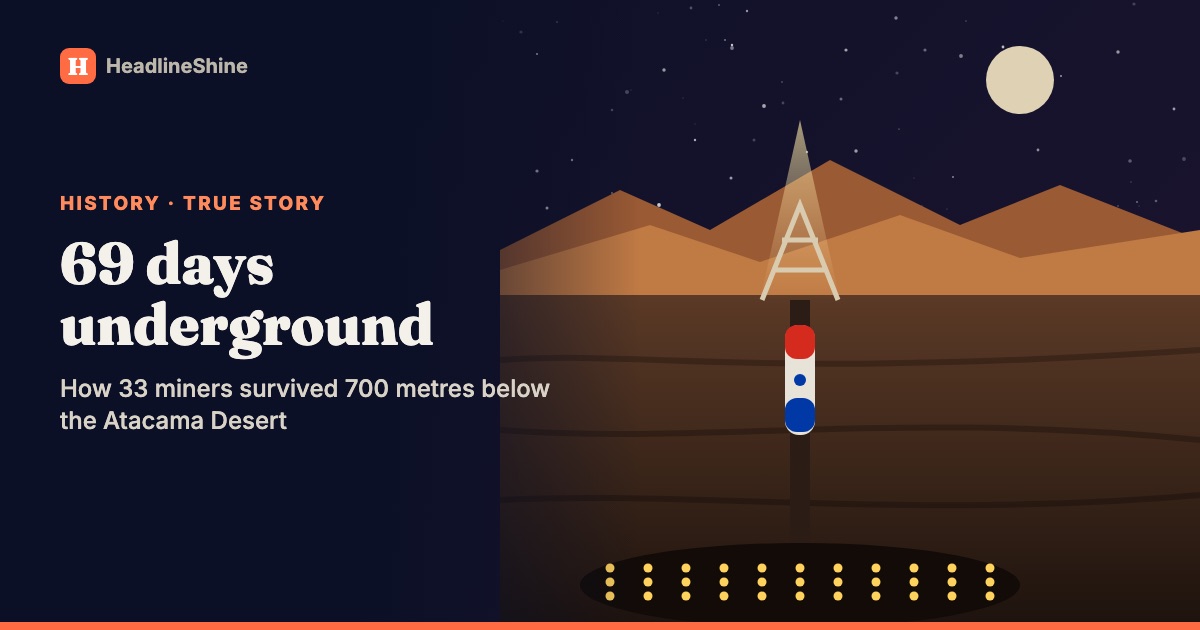
Imagine being about 700 metres under the ground. It is completely dark. A mountain of rock has sealed the way out. There is no phone signal, no fresh air and no sunlight — and the world above doesn't even know whether you are alive.
Now imagine that fear lasting not hours, not days, but 69 days. And at the end of them, with the whole world watching, 33 men come out of the earth one by one — every one of them alive.
This is not the plot of a film. It happened in Chile in 2010.
The timeline
| Date | What happened |
|---|---|
| 5 Aug 2010 | Part of the San José gold and copper mine collapses; 33 men are trapped |
| 5–22 Aug | 17 days of silence — rescuers drill blind, families wait at the mine |
| 22 Aug | A drill reaches the miners and returns with the famous note |
| 30 Aug – 5 Sep | A NASA team visits to advise on health, nutrition and psychology |
| Sept – early Oct | Engineers drill and reinforce a rescue shaft wide enough for a capsule |
| 12–13 Oct | The Fénix 2 capsule brings all 33 miners up, one at a time |
A mine in the driest desert on Earth
The San José mine lies near the city of Copiapó, in Chile's Atacama Desert — one of the driest places in the world — about 800 km (500 miles) north of the capital, Santiago. It mined gold and copper.
On the morning of 5 August 2010, the miners picked up their helmets and lamps and went to work, as on any other day. Above ground, the desert was still. Below it, the rock was under stresses no one could see. That afternoon, a huge section of the mine collapsed, and the only way out was sealed by rock.
The first 17 days: discipline in the dark
These were the most frightening days of the story. Above ground, nobody knew whether anyone had survived. Below, the 33 men gathered around an emergency shelter — a small space with only a few days' worth of food.
They had to make that food last more than two weeks. They shared it out in tiny portions, saved their strength and, just as importantly, protected each other's spirits. Shift supervisor Luis Urzúa helped keep the group organised. In a place like that, leadership is not about giving orders — it is about keeping panic from spreading.
Underground, darkness swallows time as well as light. Day and night blur together. Every distant sound of a drill makes hearts race; every shift in the rock makes breath stop.
The note that shook the world
On 22 August 2010, one of the rescuers' boreholes finally broke through. When the drill came back up, a small, dusty note was tied to it:
"Estamos bien en el refugio los 33." — "We are fine in the shelter, the 33 of us."
After 17 days of silence, those eight words told the world that every single miner was alive. Families who had camped at the mine broke down in joy. But a harder question followed at once: how do you bring 33 people up through 700 metres of solid rock?
Life in a world underground
Once the miners were found, a narrow borehole became their lifeline. Food, water, medicine and letters from home were sent down in tubes. The men organised themselves — sharing jobs, keeping a routine and looking after anyone who was struggling.
The rescue didn't only come from above. It began below, the moment the miners decided not to give up.
Why NASA came to help
Chile asked NASA for advice, because astronauts face some of the same problems: long isolation, cramped spaces, limited supplies and constant risk. A NASA team — including doctors, a psychologist and an engineer — visited the mine from 30 August to 5 September. They advised on medical care, nutrition and psychological support, and later helped write the engineering requirements for the rescue capsule.
Fénix: the capsule that brought them home
The rescue capsule was named Fénix — the phoenix, the mythical bird that rises again from its ashes.
- It was about 4 metres (13 feet) tall but only 53 cm (21 inches) wide — just enough for one person.
- Inside, each miner had an emergency oxygen supply, audio and video links to the surface and sensors checking his heart rate.
- An escape hatch in the bottom meant a miner could be lowered back down if the capsule got stuck.
- The trip up took about 10 to 15 minutes.
Engineers used Fénix 1 to test the system; Fénix 2 carried out the real rescue. Meanwhile, drillers — helped by an American drilling-tool company — bored and reinforced the escape shaft wide enough for it to pass.
The rescue night
The final operation began on the night of 12 October 2010, broadcast live to millions of people around the world. Chile's president, Sebastián Piñera, waited at the shaft with families and rescuers.
The first miner, Florencio Ávalos, climbed into the capsule. Minutes later, it rose into the floodlights, and the crowd erupted. It proved the system worked — and that the other 32 really could come home.
Then the same nerve-racking routine was repeated again and again: the capsule went down, a miner climbed in, the cable pulled, every eye fixed on the hole — until it reappeared.
The last miner to come out was the shift supervisor, Luis Urzúa, who had helped hold the group together underground. On 13 October 2010, less than 24 hours after the first ascent, all 33 men were free. Wearing dark glasses to protect their eyes after weeks in the dim mine, they ranged in age from 19 to 63 — and almost all were in good health.
By the numbers
| Miners trapped | 33 |
| Depth | about 700 metres (2,300 feet) |
| Days with no contact | 17 |
| Days underground | 69 — longer than anyone had survived trapped underground before |
| Capsule width | 53 cm (21 inches) |
| Time per ride up | 10–15 minutes |
| Miners rescued alive | 33 of 33 |
What the story teaches us
Technology built the way out, but people kept hope alive. The drill cut through rock, but discipline got the miners through the days. The capsule lifted their bodies — but trust kept their minds from breaking.
Hope, this story shows, isn't just a feeling. It needs discipline, planning and hard work — and sometimes, a path through the rock just 53 centimetres wide.
This article is based on research by Yatendra Singh for an upcoming HeadlineShine documentary on YouTube. Sources: NASA History Office, Smithsonian Magazine, Smithsonian Institution, History.com and AP.
Would you have kept hope alive down there? React below, and share this true story with someone who needs a little courage today.