The result
| Lula (PT) | Flávio Bolsonaro (PL) | |
|---|---|---|
| Runoff, 25 Oct | 64.3 million votes · 51.79% | 59.8 million votes · 48.21% |
| First round, 4 Oct | 53.9 million · 45.16% | 56.1 million · 47.03% |
Lula came second in the first round and still won — the first time that has happened since Brazil returned to democracy. Turnout rose sharply in the runoff, with about 14 million more people voting, and Lula won the most votes of his career.
"No one is required to like the president-elect, but he must govern for everyone," Lula said after his victory.
Did Bolsonaro accept it?
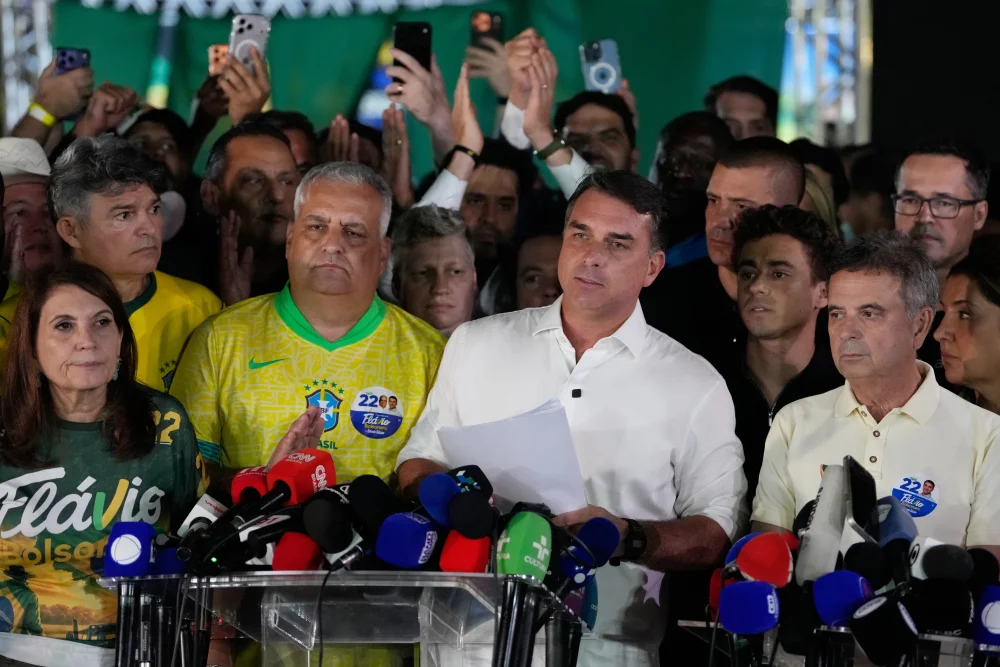
Not straight away. Flávio Bolsonaro called the result "not normal" and talked about seeking to annul it, partly because a Supreme Court judge extended voting by two hours in some areas because of transport problems and rain. On 26 October his party, the PL, said it recognised the result, though as of 27 October he had not formally conceded.
Brazil's electoral court said it had "absolute confidence" in the vote. Leaders including Emmanuel Macron, Pedro Sánchez, Claudia Sheinbaum and Mark Carney congratulated Lula, as did China and Russia. Donald Trump said it "looked like another rigged election", while saying he did not take sides.
Lula's Amazon record, in numbers
Brazil's space agency, INPE, measures how much Amazon rainforest is cleared each year (August to July):
The 2026 figure — about 3,335 km² — is the lowest since records began, down roughly 71% from 2022. It is a preliminary estimate and may be revised.
What changed under Lula:
- Stronger enforcement by the environment agency, Ibama, against illegal clearing and gold mining.
- The Amazon Fund, frozen under Jair Bolsonaro, was restarted in 2023, with Norway and Germany resuming donations and the US and Switzerland joining.
- At the COP30 climate summit in Belém in November 2025, Brazil launched the Tropical Forests Forever Facility, a fund that pays countries to keep forests standing. It had pledges of more than $6 billion by the end of the summit.
- His 2026 campaign promised zero deforestation by 2030.
The criticisms
Environmental groups say the picture is not all green:
- Oil near the Amazon's mouth: in 2025 Ibama allowed Petrobras to drill an exploration well off the coast of Amapá, and the company has since reported finding oil and gas there.
- The BR-319 highway, which would cut through one of the most intact parts of the forest. The government announced $75 million for it in 2026, alongside a protection plan.
- The "devastation bill": a 2025 law that lets many projects and farms skip full environmental licensing. Lula vetoed parts of it, but Congress overturned most of his vetoes.
- Fires: in 2024, a drought helped fires burn the largest area in Brazil since 2019 — most of it in the Amazon.
What happens next
Lula, now 81, starts his new term on 5 January 2027 — but with a Congress that leans to the opposition. Bolsonaro's PL won the largest bloc in the lower house since 1988, which could make it harder to pass environmental laws or block ones he opposes.
His Amazon goal is clear: zero deforestation by 2030. The 2026 figure shows Brazil is closer than it has ever been — but oil, roads and farm interests will test that promise over the next four years.
Sources: results from Brazil's electoral court via Agência Câmara; Al Jazeera, AP via ABC News, NPR, France 24; deforestation data from INPE, the Brazilian government and ((o))eco; TFFF; Mongabay; World Oil; AP via OPB.
Can Brazil reach zero deforestation by 2030? React below and share this with someone who cares about the Amazon.